 Agentic World
From LLM to Agentic AI
How we got from clever autocomplete to autonomous systems - explained in plain language.
Think of it as hiring someone brilliant and slowly making them actually useful at your company. Each stage below is one thing you give them.
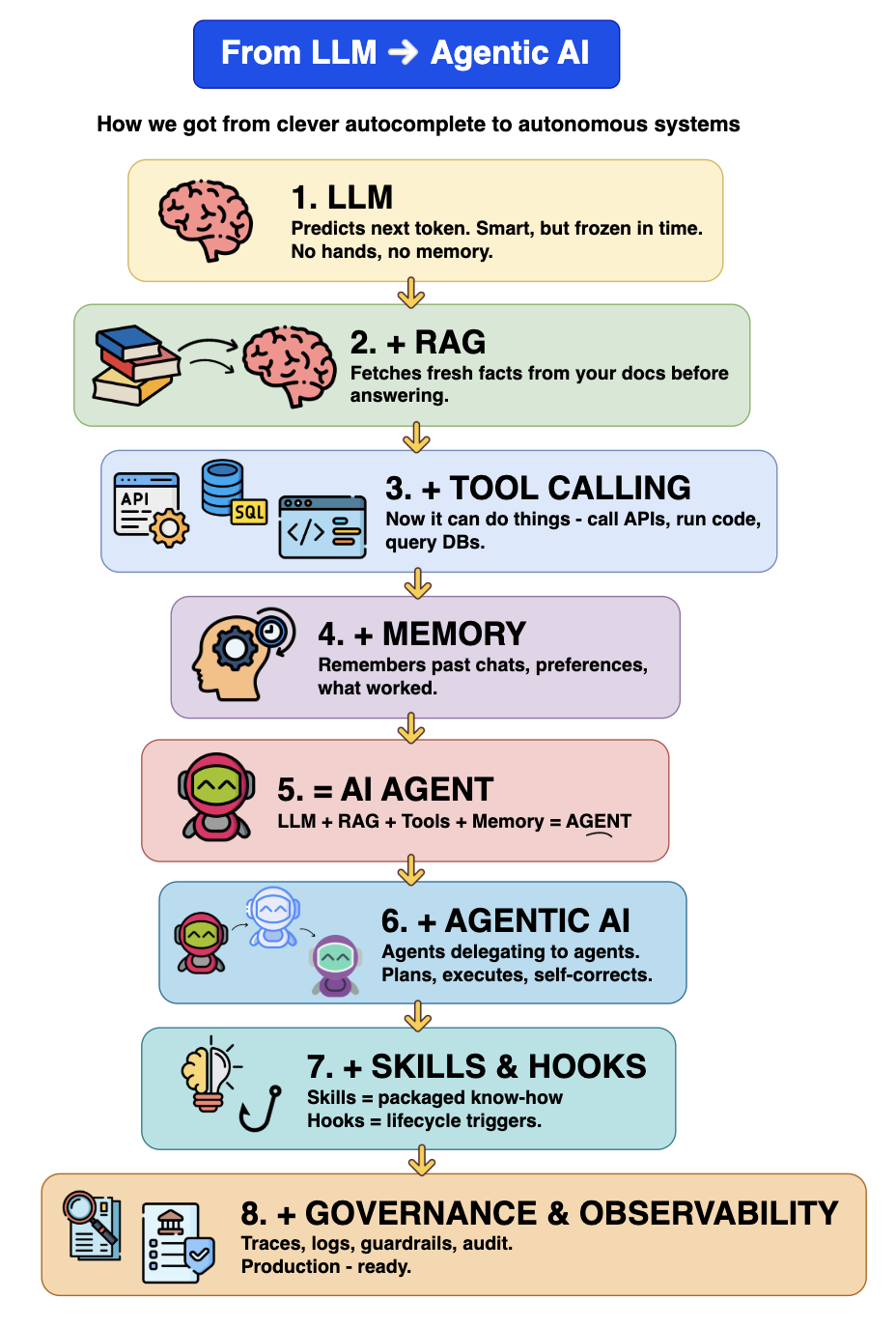
1. LLM - the brilliant new hire on day one
They’ve read everything, they’re sharp, they can talk about anything. But they know nothing about your company, they can’t pick up a phone, and they forget you the moment you leave the room.
Pure thinking, no doing.
2. + RAG - give them the filing cabinet
Before answering, they go look it up in your documents. Now instead of “here’s how expense policies generally work,” you get “here’s your expense policy, updated last March.”
Same brain, but grounded in your reality instead of vague memory.
3. + Tool calling - give them hands
Until now they could only talk. Now they can act: call an API, run a query, send an email, execute code.
This is the biggest leap in the whole chain - the moment the system stops being an advisor and starts being a worker.
4. + Memory - give them a notebook
They remember you. Your preferences, what you asked last week, which approach failed. Without this, every conversation starts from zero - like a colleague with amnesia.
With it, they get better at working with you specifically.
5. = AI Agent - that’s the employee
Nothing new here. It’s just the name for the sum: a brain, that reads your docs, has hands, and remembers. Give it a goal instead of a script, and it figures out the steps itself.
That’s the definition of “agent” - you say what, not how.
6. + Agentic AI - now it’s a team, not a person
One person can’t do everything. So agents hire agents: a planner breaks the work down, specialists handle pieces, someone reviews the output and sends it back if it’s wrong.
The self-correction loop matters more than the delegation - a team that checks its own work is what makes multi-step tasks survivable.
7. + Skills & Hooks - the company handbook and the standard procedures
- Skills are packaged know-how: “here’s exactly how we do a client onboarding” - so the agent doesn’t reinvent it badly each time.
- Hooks are the rules that fire automatically at certain moments: before you deploy, run the tests; after any refund, log it.
Together: less improvisation, more institutional muscle memory.
8. + Governance & Observability - badge, camera, and audit trail
Everything above makes it powerful. This makes it employable. You can see what it did and why (traces), stop it doing things it shouldn’t (guardrails), and prove any of it to an auditor later.
Skip this and you have an impressive demo. Include it and you have production.
The through-line
| Stages | What they add |
|---|---|
| 1-4 | Capability |
| 5-7 | Autonomy |
| 8 | Trust |
Most teams get very excited about the middle and discover the hard way that the last one is what actually determines whether the thing ever leaves the lab.