 Agentic World
Agentic AI Concepts
Agentic AI - The Big Picture
A plain-language walkthrough of the core concepts: what an agent is, how it thinks and works, and what makes it reliable in production.
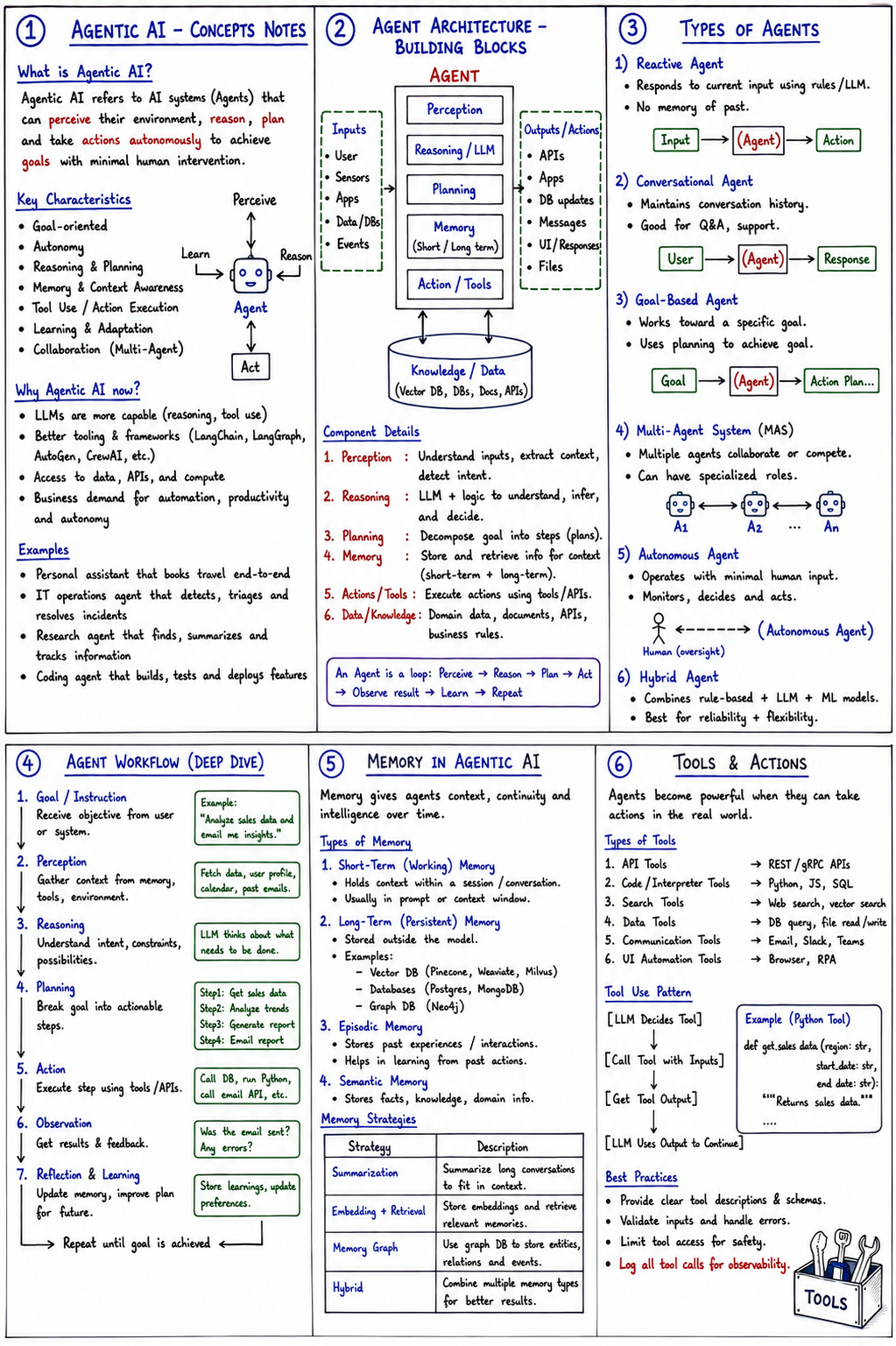
1. Agentic AI - Concepts
An LLM on its own just answers questions. An agent is what you get when you point that brain at a goal and let it act on its own: it looks at the situation, thinks, makes a plan, does something, checks the result, and adjusts - with barely any hand-holding.
The core loop is the whole idea:
perceive -> reason -> act -> learn -> repeat
Why now? Because the brains (LLMs) finally got good enough at reasoning, the tools to wire them up matured, and businesses genuinely want work done without a human in every loop.
2. Agent Architecture - Building Blocks
This is what’s actually inside an agent. Inputs come in (a user, sensors, data, events), and the agent runs them through five parts:
- Perception - understand what’s being asked
- Reasoning - the LLM decides what to do
- Planning - break it into steps
- Memory - hold context, short and long term
- Action / Tools - actually go do it
Underneath sits a knowledge store it can pull facts from. This panel is just naming the organs of the thing - the same loop from panel 1, drawn as machinery.
3. Types of Agents
Not all agents are equally clever, and that’s on purpose - you match the type to the job.
| Type | What it does | Good for |
|---|---|---|
| Reactive | Responds to current input, no memory | Simple rules; fast |
| Conversational | Remembers the chat | Support, Q&A |
| Goal-based | Plans toward an outcome | Multi-step tasks |
| Multi-agent (MAS) | Several specialized agents cooperating | Complex, divided work |
| Autonomous | Runs with almost no oversight | Monitoring, self-driving processes |
| Hybrid | Mixes rules + LLM + ML | Reliability + flexibility |
The lesson: more autonomy isn’t always better - pick the simplest type that does the job.
4. Agent Workflow - Deep Dive
This zooms into one full pass of the loop, step by step:
- Goal - get the objective from a user or system
- Perception - gather context from memory, tools, environment
- Reasoning - figure out intent and constraints
- Planning - break the goal into actionable steps
- Action - execute a step using tools / APIs
- Observation - look at the result and feedback
- Reflection & Learning - update memory, improve the plan
…then repeat until the goal is achieved.
Made concrete: the goal is “analyze sales data and email me insights,” so it fetches the data, thinks, plans four steps, runs Python, checks “was the email actually sent?”, and stores what it learned.
The observation and reflection steps are what separate a real agent from a script - it notices when something went wrong and corrects.
5. Memory in Agentic AI
Memory is what turns a goldfish into a colleague.
- Short-term (working) - the current conversation; lives in the context window
- Long-term (persistent) - stored outside the model in databases, survives across sessions
- Episodic - “what happened last time”; past experiences it can learn from
- Semantic - plain facts and domain knowledge
Because you can’t cram everything into the context window, there are strategies to manage it: summarize old chats, embed + retrieve only the relevant bits, use a memory graph of related facts, or a hybrid of these.
This is usually where real agent projects succeed or fail - get memory wrong and the agent feels forgetful and unreliable.
6. Tools & Actions
An agent that can only talk is a chatbot; tools are what let it do things in the real world - call APIs, run code, search, read/write databases, send Slack messages, drive a browser.
The pattern is always the same:
LLM decides it needs a tool -> calls it with inputs -> gets the output -> continues
Best practices (the part experience teaches you the hard way):
- Describe your tools clearly, with proper schemas
- Validate inputs and handle errors
- Limit what the agent is allowed to touch, for safety
- Log every single tool call - because when an autonomous system misbehaves, the logs are the only way you’ll ever understand what it did
The thread tying it together
| Panels | Theme |
|---|---|
| 1-2 | What an agent is |
| 3-4 | How it thinks and works |
| 5-6 | What makes it reliable in production |
Memory so it doesn’t forget, and disciplined tool use so it doesn’t go off the rails - that’s what carries an agent from an impressive demo to something you can actually trust in production.