 Agentic World
The Evolution of Agentic AI
The Evolution of Agentic AI - A Journey
Every architectural era is defined by where the bottleneck sits. When you fix a bottleneck, you don’t get a better version of the old thing - you get a whole new discipline. That’s exactly the arc Agentic AI has walked in about four years: four bottlenecks, four disciplines.
Told through one running analogy - a brilliant new hire who starts by being handed a note and ends up running a factory floor.
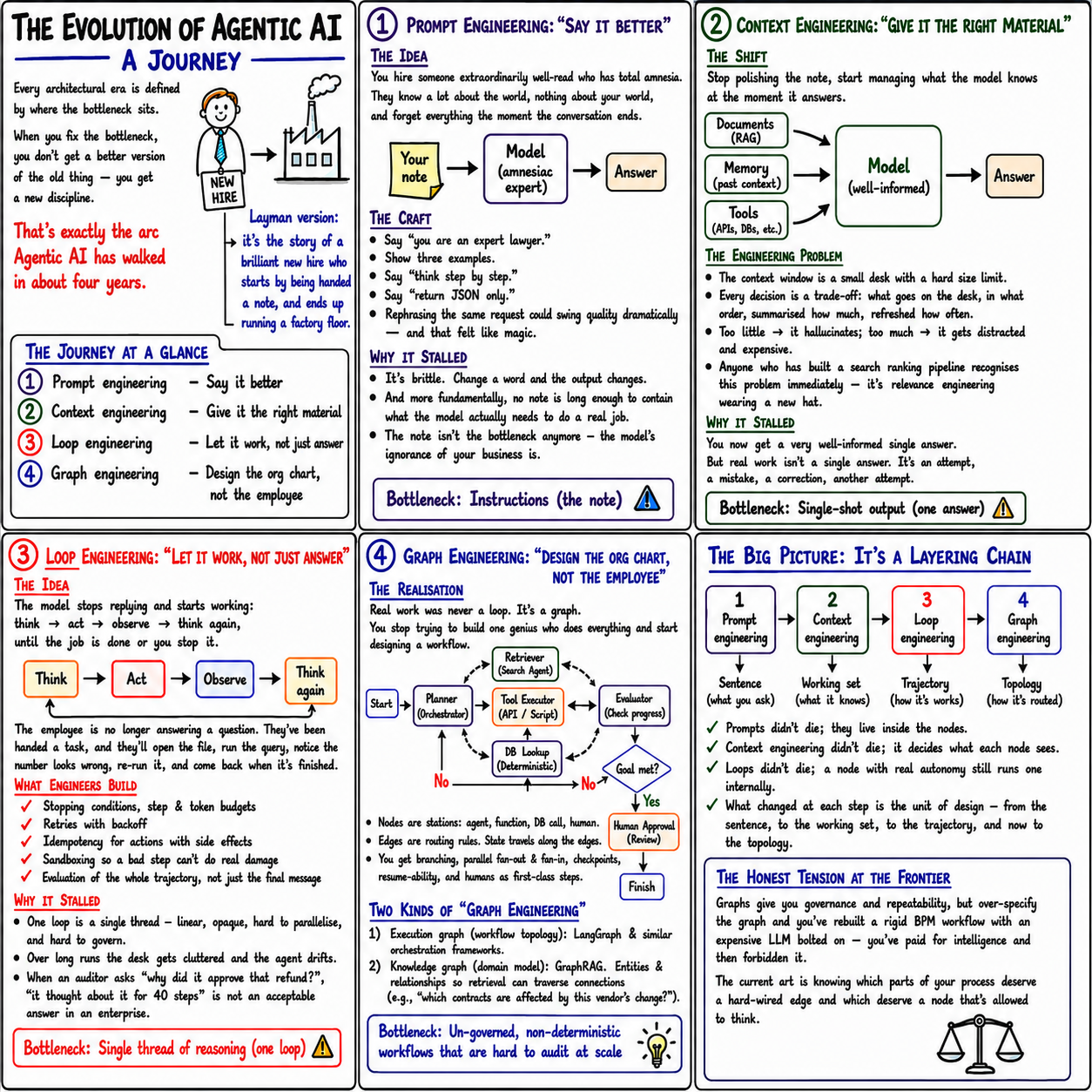
The journey at a glance
| Stage | Discipline | In a phrase |
|---|---|---|
| 1 | Prompt engineering | Say it better |
| 2 | Context engineering | Give it the right material |
| 3 | Loop engineering | Let it work, not just answer |
| 4 | Graph engineering | Design the org chart, not the employee |
1. Prompt Engineering - “say it better”
The idea. You’ve hired someone extraordinarily well-read but with total amnesia: they know everything about the world, nothing about your world, and forget it all the moment the conversation ends.
The craft. So at first you obsess over how you word the note you hand them:
- “You are an expert lawyer.”
- Show three examples.
- “Think step by step.”
- “Return JSON only.”
Rephrasing the same request could swing quality dramatically - and that felt like magic.
Why it stalled. It’s brittle: change a word and the output changes. And more fundamentally, no note is ever long enough to contain what the model needs to do a real job. The wording was never the bottleneck - the model’s ignorance of your business was.
Bottleneck: Instructions (the note)
2. Context Engineering - “give it the right material”
The shift. Stop polishing the note; start managing what the model actually knows the moment it answers - feeding it your documents (RAG), past context (memory), and live data (tools).
The engineering problem. The context window is a small desk with a hard size limit. Every decision is a trade-off: what goes on the desk, in what order, summarised how much, refreshed how often.
- Too little → it hallucinates.
- Too much → it gets distracted (and expensive).
- Anyone who’s built a search-ranking pipeline recognises this instantly - it’s relevance engineering wearing a new hat.
Why it stalled. You now get a very well-informed single answer. But real work isn’t a single answer. It’s an attempt, a mistake, a correction, another attempt.
Bottleneck: Single-shot output (one answer)
3. Loop Engineering - “let it work, not just answer”
The idea. The model stops replying and starts working:
think → act → observe → think again - until the job is done, or you stop it.
The employee is no longer answering a question. They’ve been handed a task: they’ll open the file, run the query, notice a number looks wrong, re-run it, and come back when it’s finished.
What engineers build here.
- Stopping conditions, step & token budgets
- Retries with backoff
- Idempotency for actions with side effects
- Sandboxing, so a bad step can’t do real damage
- Evaluation of the whole trajectory, not just the final message
Why it stalled. One loop is a single thread - linear, opaque, hard to parallelise and govern. Over long runs the desk gets cluttered and the agent drifts. And when an auditor asks “why did it approve that refund?”, “it thought about it for 40 steps” is not an acceptable answer in an enterprise.
Bottleneck: Single thread of reasoning (one loop)
4. Graph Engineering - “design the org chart, not the employee”
The realisation. Real work was never a loop - it’s a graph. You stop trying to build one genius who does everything and start designing a workflow.
A planner (orchestrator) routes to a tool executor, a database lookup, and an evaluator that checks progress - with a human approval step before anything final.
- Nodes are stations: an agent, a function, a DB call, a human.
- Edges are routing rules. State travels along the edges.
- You get branching, parallel fan-out & fan-in, checkpoints, resume-ability, and humans as first-class steps.
Two kinds of “graph engineering” - people use one term for two things:
- Execution graph (workflow topology): LangGraph & similar orchestration frameworks.
- Knowledge graph (domain model): GraphRAG - entities & relationships so retrieval can traverse connections (e.g. “which contracts are affected by this vendor’s change?”).
Bottleneck: Un-governed, non-deterministic workflows that are hard to audit at scale
The big picture - it’s a layering chain
Each stage didn’t replace the last - it absorbed it.
| Stage | Unit of design | What it controls |
|---|---|---|
| 1. Prompt engineering | Sentence | What you ask |
| 2. Context engineering | Working set | What it knows |
| 3. Loop engineering | Trajectory | How it works |
| 4. Graph engineering | Topology | How it’s routed |
- Prompts didn’t die - they live inside the nodes.
- Context engineering didn’t die - it decides what each node sees.
- Loops didn’t die - a node with real autonomy still runs one internally.
- What changed at each step is the unit of design - from the sentence, to the working set, to the trajectory, and now to the topology.
The honest tension at the frontier
Graphs give you governance and repeatability. But over-specify the graph and you’ve rebuilt a rigid business-process workflow with an expensive LLM bolted on - you’ve paid for intelligence and then forbidden it.
The current art is knowing which parts of your process deserve a hard-wired edge (predictable, auditable) and which deserve a node that’s allowed to think.
The one line to remember
The field didn’t get better at prompting - it kept moving the problem up a level: from wording the request, to feeding the model, to letting it work, to architecting the whole system.